Table Of Contents
- Why Self-Service Needs Better Design
- Map The Guest Journey Before Choosing Technology
- Build A Smoother Hotel Arrival
- Make Restaurant Ordering Simple
- Keep Human Support Close By
- Design For Accessibility From The Start
- Protect Guest Privacy And Payment Data
- Measure What Guests And Staff Experience
- Use A Practical Implementation Plan
- Final Takeaway
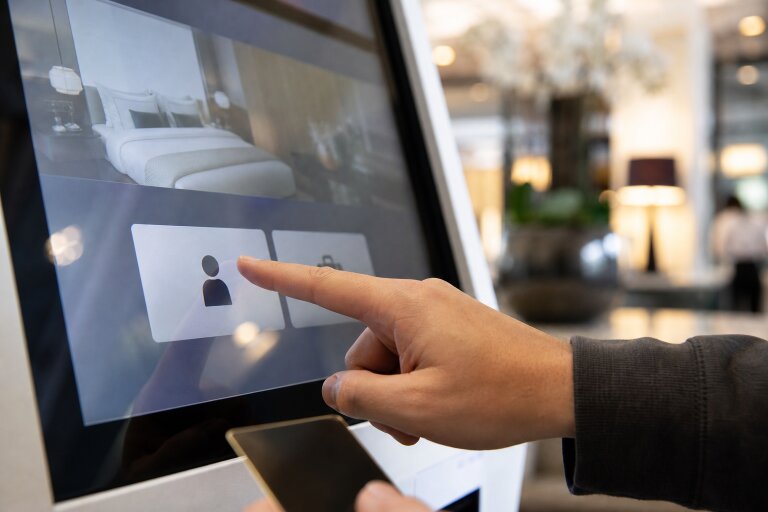
Self-service has become a practical part of hospitality, from checking into a room to customizing a meal during a busy lunch rush. The goal is not to make every guest use a screen. It is to offer a faster, clearer option for routine tasks while preserving an easy path to personal help. Well-planned hotel kiosks can support that balance when they are designed around real guest needs rather than technology alone.
For hotels and quick-service restaurants, a successful self-service journey should reduce uncertainty, repeat fewer steps, and let people move at their own pace. Guests should understand what to do next, see the total cost before committing, and know exactly where to turn if the process does not work as expected.
Why Self-Service Needs Better Design
Guests often value flexibility. A traveler arriving late may want to complete a simple check-in without waiting at a desk, while another may prefer a conversation about an upgrade, accessible room features, or local transportation. The same principle applies at a restaurant. One customer may want to reorder a familiar meal quickly, while another needs help with ingredients or a special request.
Self-service fails when it merely shifts staff work onto the guest. A useful experience removes friction by asking only for needed information, explaining unfamiliar steps, and making corrections easy. The best design gives people a choice between independent completion and prompt staff assistance.
Map The Guest Journey Before Choosing Technology
Operators should study the full journey before selecting hardware, software, payment tools, or integrations. Start with observation. Watch where people pause, abandon a task, ask the same question, or need an employee to correct an error. The process around the screen matters as much as the screen itself.
Key Steps To Review
- Identify where guests wait and why the line stops moving.
- List the questions employees answer repeatedly.
- Find places where guests or staff enter the same data more than once.
- Review frequent errors, failed payments, and unclear handoffs.
- Separate tasks guests may prefer to handle alone from tasks that benefit from personal service.
A hotel may discover that identity checks, key collection, and room directions create more delay than the reservation lookup itself. A quick-service restaurant may find that menu changes, customization choices, and payment uncertainty slow the order line. These findings create a better starting point than a generic plan to “add kiosks.”
Build A Smoother Hotel Arrival
Arrival sets the tone for the stay, particularly when guests are tired, carrying luggage, traveling with children, or arriving after a long flight. A self-service option should use clear entrance signage, large, readable text, plain language, and obvious instructions for identification, payment, key collection, and room directions.
Give guests a visible choice. A traveler with a straightforward reservation might complete the routine arrival steps quickly, then receive a room number and simple directions. At the same time, a nearby team member can help another guest resolve a reservation issue or answer a detailed request. This approach offers control without making anyone feel abandoned.
Make Restaurant Ordering Simple
Restaurant self-service can reduce ordering pressure during busy periods when the interface supports confident decisions. Start with popular categories and familiar choices. Use photos only when they genuinely clarify an item, and make ingredient details, portion information, and customization options easy to locate.
Important Ordering Principles
- Show popular choices first without hiding the full menu.
- Keep modifications and substitutions easy to understand.
- Make allergy-related information prominent and easy to review.
- Offer language choices that serve the customer base.
- Display the full price before payment.
- Provide a final review screen before an order is submitted.
- Maintain a staff-assisted option for unusual or complex orders.
Payment flexibility also matters. Customers should not have to guess which payment types are accepted or whether an order went through. Fast service is valuable, but accuracy and confidence are more important than shaving a few seconds from the process.
Keep Human Support Close By
Independent service is not the same as unsupported service. A blended model keeps trained employees within sight of the self-service area, gives guests a simple way to request help, and enables staff to resolve a failed transaction without forcing the customer to begin again.
Employees need the authority and training to step in calmly. They should be able to explain the next step, restart a session, correct an order, or move the guest to another service path. Helpful support protects the guest experience and prevents a minor problem from becoming a public point of frustration.
Design For Accessibility From The Start
Accessibility belongs in the first design review, including the physical approach, screen placement, controls, instructions, alternate communication methods, and staff support. Hotels and restaurants are among the public accommodations addressed in ADA guidance for public accommodations, which explains that access involves both the built environment and the policies used to provide goods and services.
Accessibility Checklist
- Place controls where guests can approach and reach them comfortably.
- Use strong contrast, readable type, and simple instructions.
- Provide visual, audio, or tactile support where appropriate.
- Keep pathways clear around self-service areas.
- Offer assistance respectfully, without singling out guests.
- Test the journey with people who have varied access needs.
Protect Guest Privacy And Payment Data
Self-service journeys may process reservation details, names, payment information, loyalty records, identification data, and service requests. Operators should define what information is collected, why it is needed, who can access it, how long it is retained, and what happens automatically when a session ends.
Security planning should also include software updates, access controls, monitoring, and an incident response process. NIST guidance on securing property management systems highlights practices such as role-based authentication, tokenization of payment data, and monitoring for anomalies. These safeguards support a wider effort to limit unnecessary exposure of guest information.
Measure What Guests And Staff Experience
A rollout should be evaluated by more than transaction volume. Track average completion time, abandoned sessions, payment or identity-check failures, requests for assistance, order corrections, uptime, and staff feedback during peak periods. Review results by location, time of day, task type, and language option to find issues that broad averages may hide.
Use A Practical Implementation Plan
- Choose one clear problem. Begin with a task that creates visible delays or repeated questions.
- Document the current process. Capture steps, handoffs, errors, and common guest concerns.
- Design the simplest path. Remove unnecessary screens and repeated data entry.
- Test with real users. Include people with varied abilities, languages, ages, and comfort levels with technology.
- Train staff before launch. Make sure employees can help, override, restart, and report issues.
- Run a limited pilot. Observe performance during both quiet and busy periods.
- Adjust before expanding. Fix confusing steps before introducing the experience at more locations.
Final Takeaway
Better self-service is not about adding more technology. It is about making routine tasks easier while protecting choice, accessibility, privacy, and human connection. Hotels and quick-service restaurants that begin with genuine guest problems can build journeys that feel faster, calmer, and more dependable throughout 2026.